Jakarta receives about 2,000mm of rain every year. Yet many households still rely on groundwater for daily washing, cleaning, and sanitation. The issue is not a lack of rain; it is the way the city meets everyday water demand.
of Jakarta's 11 million residents lack piped water access
World Bank, 2024
per year — sinking rate in the worst areas of North Jakarta
MDPI Water Journal, 2024
of affected households spend over 5% of income on water alone
The Conversation, 2023
the year North Jakarta could be permanently underwater
Jakarta Post, 2024
more expensive — informal vendor water vs. piped tariff
The Conversation, 2023
annual rainfall in Jakarta — largely uncollected, flowing to waste
BMKG Indonesia, 2024
PAM Jaya, Jakarta's state utility, covers only ~70% of the city. The poorest kampung settlements are the last in line — and have been waiting for decades.
With no alternative, millions install private pumps and extract groundwater daily. It appears "free" — but the hidden cost is catastrophic. Pumping is nearly impossible to regulate at household scale.
Underground water tables drop. The soil above — no longer supported by water pressure — compacts and collapses. Jakarta's concrete surfaces block natural rainwater recharge, accelerating the problem.
The city sinks. North Jakarta has dropped 2.5 metres in the last decade. Some areas are now 60–100cm below sea level. Infrastructure cracks. Pipes break. Saltwater intrudes into remaining groundwater.
Sunken land cannot drain. Heavy rains — of which Jakarta receives plenty — turn into floods that damage homes, disrupt schools and livelihoods, and force displacement. The poorest communities lose the most.
Contaminated, saltwater-intruded groundwater becomes less usable. Households turn to expensive vendors or continue pumping deeper. The cycle tightens unless daily demand is reduced.
PAM Jaya's network expansion has stalled for years. Infrastructure investment requires billions. Political incentives favour visible projects over essential maintenance. Enforcement of the 2026 groundwater ban remains minimal.
Water vendors exploit monopoly positions in unserved kampungs, charging 10–32× the piped tariff. There is no profit incentive to serve poor communities fairly. The market maximises revenue — not access.
Donor-funded water projects exist — but a charity rupiah is spent once and gone. When funding ends, so does the project. Past rainwater harvesting initiatives in Jakarta failed due to community mistrust and no maintenance model.
In Jakarta's kampung settlements, a family of four can spend up to 30% of monthly income on water — bought litre by litre from informal vendors.
Women and girls often carry the burden of collecting water, queueing, negotiating vendor prices, and managing household use when supply is unreliable.
This is not a natural disaster. It is a systemic failure — of infrastructure, of governance, and of market access.
See how RainBank helps
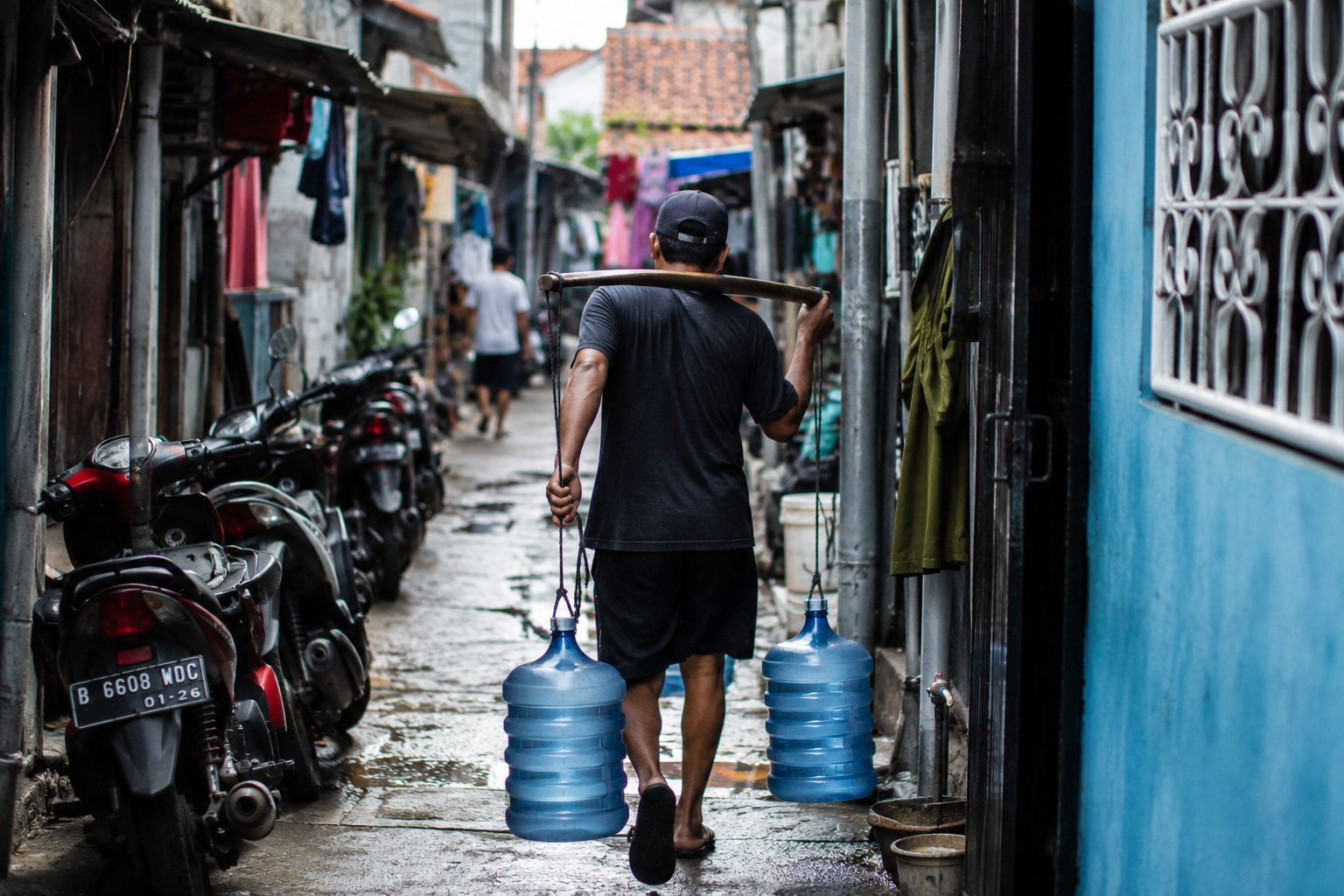
"When piped water does not reach the house, families still need water for washing, cleaning, and toilets every day."
— RainBank field assumption for pilot planning
Rainwater harvesting is familiar technology. RainBank's contribution is the operating model: local ownership, basic treatment for non-potable use, transparent fees, and maintenance funded by hub revenue.
How It Works