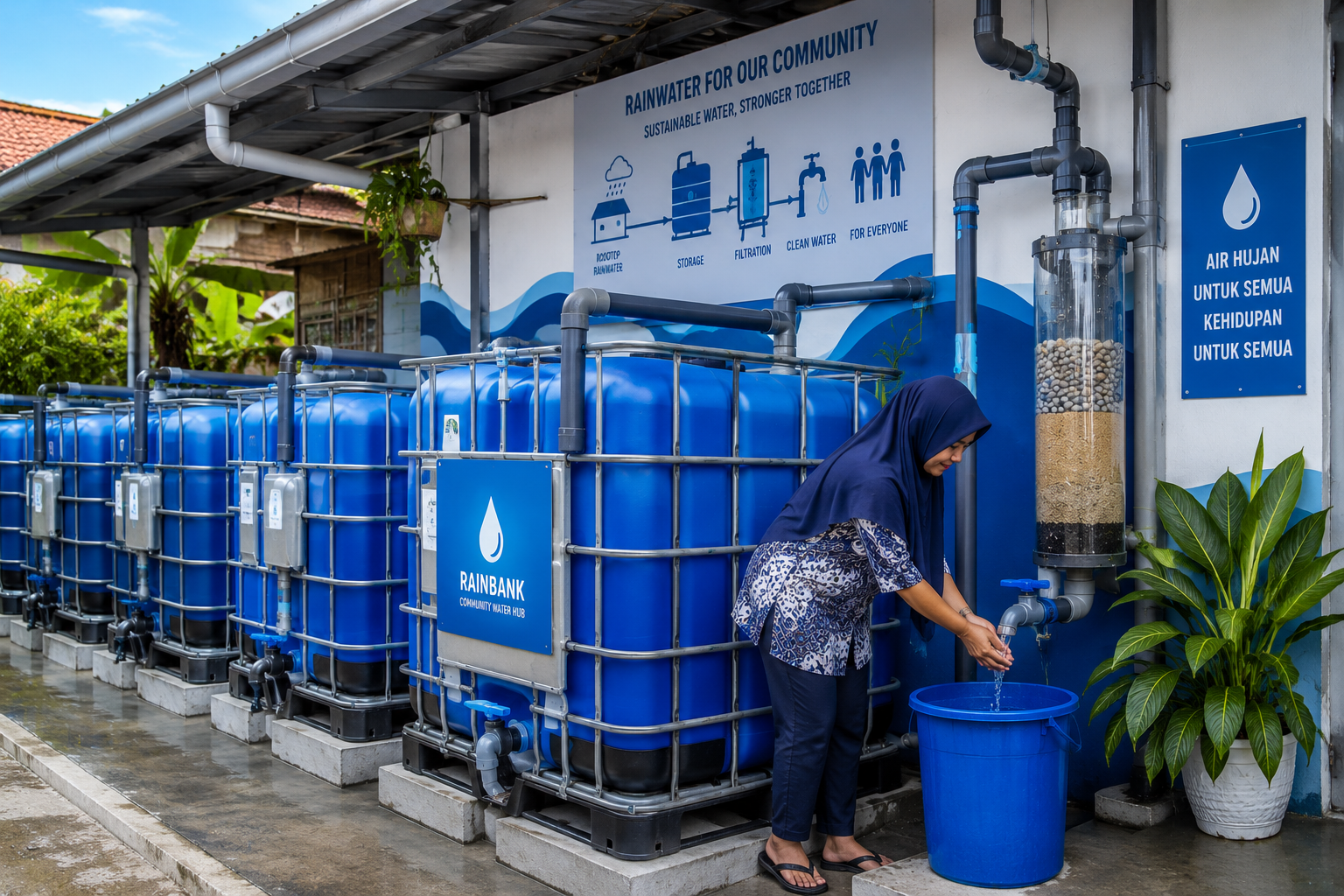
RainBank's impact is estimated by how much non-potable water demand can shift away from groundwater pumping, informal vendors, and unmanaged runoff.
theoretical usable collection from a 300m² roof per year
Per-hub model · 2,000mm rainfall × 75% efficiency
households partially served per hub, depending on demand and storage
Pilot assumption · 50–100 households
potential discount versus selected informal non-potable water purchases
Scenario estimate · pricing depends on local vendor rates
local roles linked to operation, maintenance, and distribution
Pilot assumption · role count depends on hub size
maximum annual groundwater demand offset if collected rainwater replaces pumped water
Conservative projection · actual displacement must be measured
projected capital recovery window under pilot assumptions
Pilot assumption · 20–30 months
More reliable access for washing, cleaning and sanitation can reduce pressure on households that currently rely on vendors or groundwater pumps for basic daily needs.
The model targets lower costs for selected water uses, local operator income, and a maintenance reserve before any expansion is considered.
RainBank captures rainfall locally and uses it to reduce groundwater demand for non-potable tasks. This supports aquifer protection and reduces runoff during rain events.
Before RainBank
collecting water from distant vendors or standpipes. Mostly women and girls.
from informal vendors. Up to 30% of household income spent on water.
fully dependent on informal vendors for bathing, washing, and sanitation water — no fallback when prices spike or supply dries up.
vendor prices fluctuate. Dry season sees price spikes of up to 50%. Families have no alternative.
After RainBank
Water is collected from a local refill point during normal daily movement.
Membership or pay-per-fill pricing can reduce spend on washing, cleaning, and sanitation water where vendor prices are high.
Settled and filtered water is intended for bathing, washing, cleaning, toilet flushing, and community facility use.
The host institution and operator manage access, maintenance logs, and pricing transparency.
Scenario-based projection: 50 hubs across North and Central Jakarta's most underserved kampungs by Year 5. The network effect makes each new hub cheaper and faster to build.
people with partial non-potable water access
Scenario-based projection
created within communities
Scenario estimate · 3 roles per hub × 50 hubs
groundwater not pumped per year
450kL × 50 hubs · conservative projection
Every RainBank Hub is co-built with the community it serves. The mosque or school that hosts the hub receives a share of monthly revenue — ensuring long-term institutional buy-in.
Community members are involved in monitoring from day one. Monthly service reports are posted publicly at the hub, including water collected, water distributed, maintenance, and any bulk-water support.
After capital recovery, surplus remains with the community for maintenance, operator continuity, school or mosque needs, or expansion. The exact allocation is part of the pilot governance model.
See the Business ModelThe next step is a pilot with a host institution, community operator, and transparent measurement of water collected, water distributed, and groundwater demand offset.
Discuss a pilot